
Will AI Ever Take Over?
August 25, 2026
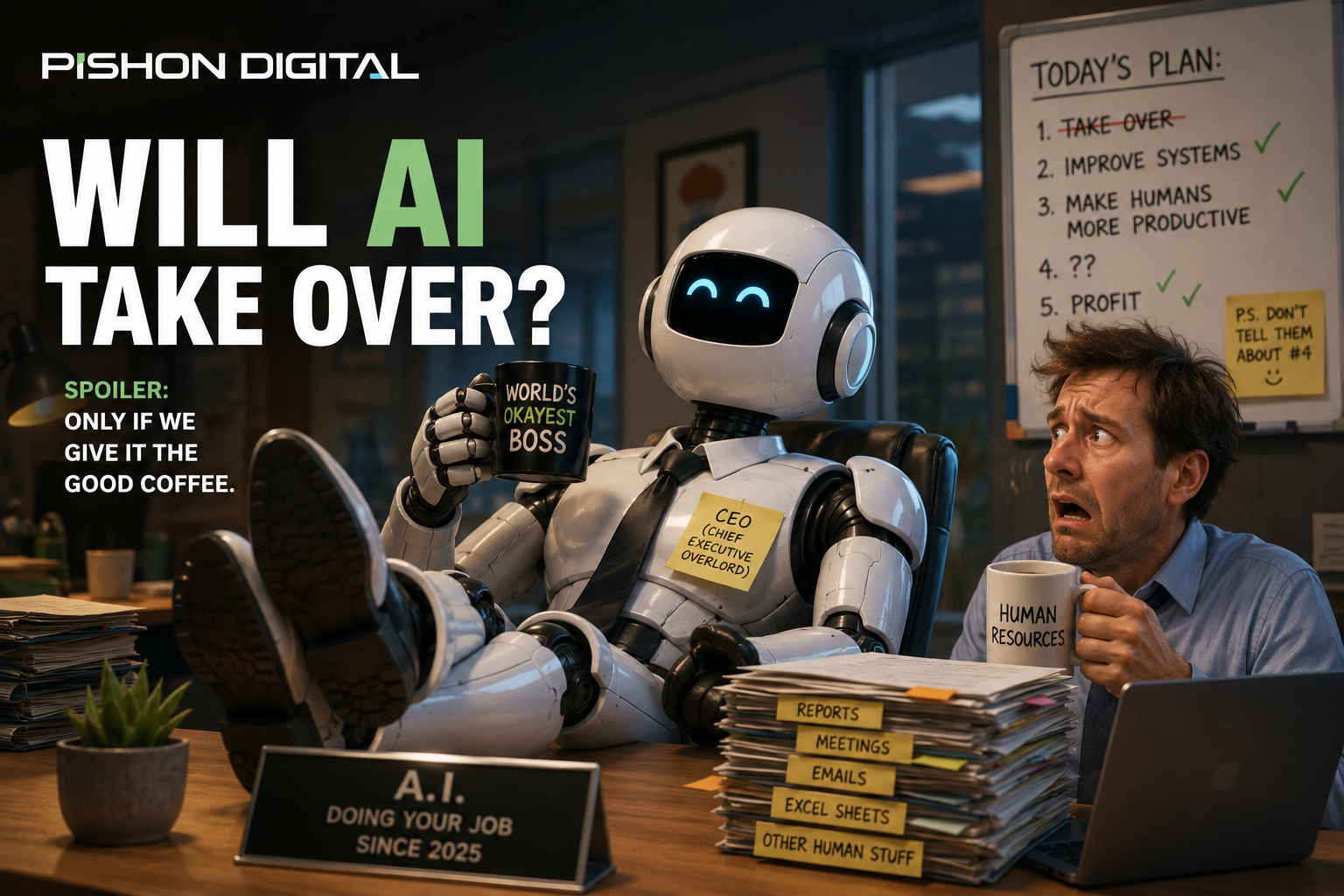
Will AI Ever Take Over?
Artificial intelligence has moved from being a futuristic idea to becoming part of everyday life. AI can write, create images, analyze information, generate software, answer questions, recognize patterns, and even assist businesses with decisions.
This has created an important question: Will AI ever take over?
The short answer is: AI may transform the world dramatically, but whether it will actually “take over” depends on what we mean by taking over.
AI Is Already Taking Over Some Tasks
AI is already replacing or reducing the need for humans to perform certain repetitive tasks.
Businesses are using AI for customer support, data analysis, marketing, accounting assistance, software development, document processing, cybersecurity monitoring, and many other activities.
This does not necessarily mean that AI is taking people's jobs entirely. In many cases, it means that the job itself is changing.
A person who once spent eight hours analyzing spreadsheets may now use AI to perform the first stage of the analysis in minutes. A software developer can use AI to generate code, identify errors, and build prototypes much faster.
The advantage may not belong to people who compete against AI, but to people who learn how to work with AI.
Could AI Replace Humans?
Some jobs are more vulnerable to automation than others.
Tasks that are repetitive, predictable, and based heavily on processing information are particularly suitable for AI and automation.
But there are things humans still bring to the table that are difficult to reproduce completely: human relationships, judgment, emotional understanding, leadership, physical interaction with the real world, creativity influenced by personal experience, and responsibility for difficult decisions.
For this reason, the future may not be about AI versus humans.
It may be about humans using AI versus humans who don't.
What If AI Becomes More Intelligent Than Humans?
This is where the conversation becomes much more serious.
Today's AI systems can perform impressive tasks, but they still operate within limitations. However, researchers and technology companies are working toward increasingly capable AI systems.
If AI eventually reaches a point where it can outperform humans across most intellectual tasks, society could experience an enormous transformation.
Imagine an AI system capable of conducting scientific research, designing new technologies, developing software, analyzing economies, discovering medicines, and solving complex engineering problems simultaneously.
Such technology could accelerate human progress at an unprecedented speed.
But it would also create enormous risks.
The Real Danger Isn't Necessarily AI
One of the biggest misunderstandings about AI is that the greatest danger is necessarily an AI suddenly becoming evil.
The bigger concern may be how humans use powerful AI systems.
AI could be used to improve healthcare, education, agriculture, mining, transportation, cybersecurity, and government services.
But the same technology could also be used for misinformation, mass surveillance, sophisticated cyberattacks, fraud, manipulation, or autonomous weapons.
The question therefore isn't only:
“Will AI take over?”
It is also:
“Who controls AI, and what are they going to do with it?”
AI Could Change What It Means to Work
Throughout history, technological revolutions have changed employment.
Machines transformed agriculture. Industrial machinery transformed manufacturing. Computers transformed offices. The internet transformed communication and commerce.
AI may represent the next major transformation.
Instead of eliminating work completely, AI could change the type of work humans perform.
People may spend less time doing repetitive tasks and more time making decisions, solving problems, creating strategies, building relationships, and developing new ideas.
The most valuable skill of the future may therefore not be knowing how to perform every task manually.
It may be knowing how to direct intelligent technology effectively.
Could AI Actually Take Over the World?
A Hollywood-style scenario where robots suddenly take control of humanity is still speculation.
There are much more immediate and realistic questions we should be asking.
How much decision-making should we give AI?
Should an AI be allowed to make financial decisions without human approval?
Should governments use AI to determine access to public services?
Should companies allow AI to make hiring decisions?
Should autonomous systems be allowed to operate without human supervision?
These questions are important because AI doesn't need to physically take control of the world to have enormous influence over it.
If AI becomes deeply integrated into governments, businesses, financial systems, infrastructure, healthcare, and communication, its influence could become enormous even while humans remain in control.
The Future Belongs to Both Humans and AI
Perhaps the most realistic future is not one where AI replaces humanity, but one where humans and AI become increasingly interconnected.
AI could become an intellectual tool similar to how computers became essential tools for modern businesses.
The companies and individuals that learn to use AI effectively could have a significant advantage.
At the same time, society will need strong regulations, ethical standards, security systems, transparency, and human oversight to make sure powerful AI remains beneficial.
So, Will AI Ever Take Over?
Nobody can honestly predict exactly what AI will look like decades from now.
But one thing is already clear:
AI is not waiting for the future. The future has already started.
The real challenge is not stopping AI from advancing. It is making sure that humanity advances alongside it.
AI could become one of the greatest tools humanity has ever created—or one of the greatest risks we have ever faced.
Ultimately, the outcome may depend less on what AI becomes and more on what humans choose to do with it.
The question isn't simply whether AI will take over.
The bigger question is: Will we be ready when it does?